Estimating Real Estate Development Capacity and GDV With Python
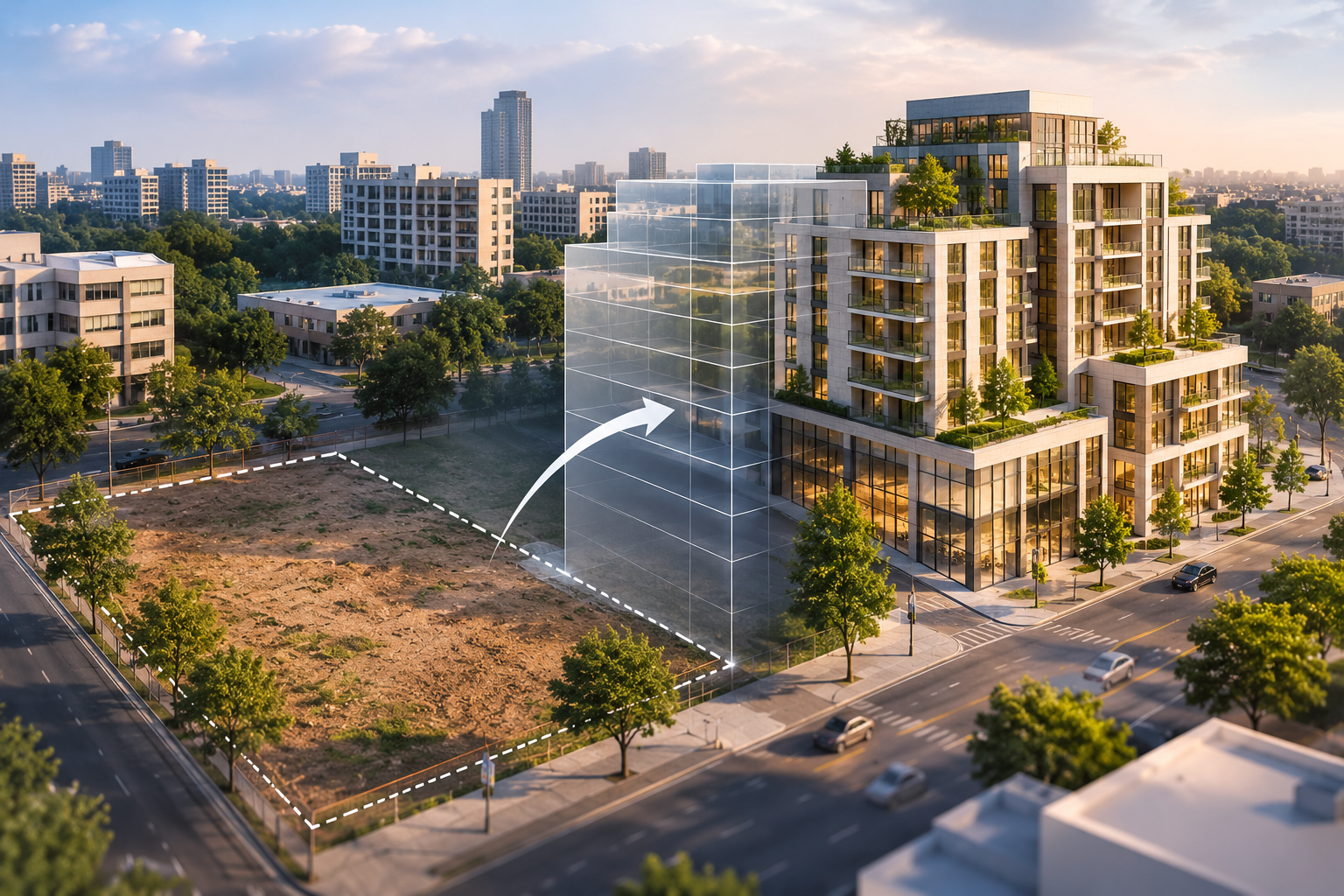
Before calculating the residual land value of a development site, a developer needs to understand what can actually be built on it and what the completed development could be worth.
This requires more than knowing the site's total area. Planning controls, permitted floor area, building efficiency, property mix, and achievable selling rates all influence the development's potential value.
These relationships form an important part of real estate feasibility analysis. If the estimated development capacity is incorrect, the resulting Gross Development Value (GDV) may also be misleading. Since GDV is a major input in residual land valuation, errors at this stage can affect the entire feasibility assessment.
In this tutorial, we'll build a small development-capacity and GDV calculator using Python. We'll start with site area and a hypothetical Floor Area Ratio (FAR), estimate gross and net saleable areas, allocate the saleable area across different property uses, and calculate the resulting GDV.
The example is simplified to demonstrate the calculation logic. Actual development capacity must be established using the applicable planning regulations, approved design, site constraints, and project-specific assumptions.
1. Understand the relationship between site area and development capacity
A development site may have a total area of 4,000 square metres, but that does not mean the developer can construct 4,000 square metres of building area.
The permitted development area depends on planning controls and other constraints. One commonly used planning measure is Floor Area Ratio.
The basic relationship is:
[ GFA = Site\ Area \times FAR ]
Where:
- GFA: Gross Floor Area.
- Site Area: The area of the development plot.
- FAR: The permitted floor area ratio.
For example, assume:
- Site area: 4,000 sqm
- Permitted FAR: 2.5
Then:
[ GFA = 4,000 \times 2.5 ]
[ GFA = 10,000\ sqm ]
The theoretical gross floor area is therefore 10,000 sqm.
This is a simplified calculation. Actual planning definitions may include or exclude particular areas, and additional restrictions such as height limits, setbacks, coverage, parking, access, and design requirements may reduce the achievable development.
For this tutorial, we'll treat the FAR assumption as an already established planning input.
2. Convert gross floor area into net saleable area
Not all gross floor area can generate direct property-sale revenue.
A building requires circulation areas, staircases, lift shafts, service spaces, common facilities, and other non-saleable areas.
To account for this difference, we introduce a development efficiency ratio.
[ NSA = GFA \times E ]
Where:
- NSA: Net Saleable Area.
- GFA: Gross Floor Area.
- E: Net-to-gross efficiency ratio.
Assume the project achieves an efficiency ratio of 80%.
[ NSA = 10,000 \times 0.80 ]
[ NSA = 8,000\ sqm ]
The model now has two important outputs:
- Gross floor area: 10,000 sqm.
- Net saleable area: 8,000 sqm.
The efficiency assumption is illustrative. Actual efficiency depends on the building design, property type, circulation requirements, and the area measurement conventions used.
3. Define the property mix
A development may contain several property types, each with a different selling rate.
For example, a mixed-use development could include residential apartments and retail space.
We'll use the following assumptions:
| Property type | Share of saleable area | Selling rate |
|---|---|---|
| Residential | 75% | $2,600/sqm |
| Retail | 25% | $3,200/sqm |
The allocated areas are:
Residential:
[ 8,000 \times 75% = 6,000\ sqm ]
Retail:
[ 8,000 \times 25% = 2,000\ sqm ]
The total allocated area is 8,000 sqm, matching the calculated net saleable area.
This reconciliation is important. If the property allocations exceed the available saleable area, the model could overstate the development's revenue potential.
4. Calculate Gross Development Value
Gross Development Value represents the estimated total value of the completed development.
For an area-based valuation:
[ GDV = \sum_{i=1}^{n}(Area_i \times Rate_i) ]
Each property category has its own saleable area and estimated selling rate.
For our example:
Residential GDV:
[ 6,000 \times 2,600 = 15,600,000 ]
Retail GDV:
[ 2,000 \times 3,200 = 6,400,000 ]
Total GDV:
[ 15,600,000 + 6,400,000 ]
[ \boxed{GDV = $22,000,000} ]
This is the estimated gross value of the completed development based on the assumed selling rates.
It is not the project's profit. Construction costs, professional fees, financing costs, taxes, sales expenses, developer profit, and other relevant items still need to be considered in a complete feasibility assessment.
5. Represent the assumptions in Python
We'll now convert the development assumptions into structured data.
Use Python's Decimal type for monetary calculations and area assumptions.
Create a file named development_capacity.py.
from decimal import Decimal
from dataclasses import dataclass


@dataclass
class DevelopmentInputs:
    site_area: Decimal
    far: Decimal
    efficiency: Decimal


@dataclass
class PropertyType:
    name: str
    area_share: Decimal
    selling_rate: Decimal
The first class represents the site's development assumptions. The second represents an individual property category.
This structure separates site-level planning inputs from property-level revenue assumptions.
Next, define the validation function.
def validate_inputs(inputs, property_types):
    if inputs.site_area <= 0:
        raise ValueError(
            "Site area must be greater than zero"
        )

    if inputs.far <= 0:
        raise ValueError(
            "FAR must be greater than zero"
        )

    if not (
        Decimal("0") < inputs.efficiency <= Decimal("1")
    ):
        raise ValueError(
            "Efficiency must be greater than 0 and at most 1"
        )

    if not property_types:
        raise ValueError(
            "At least one property type is required"
        )

    total_share = Decimal("0")

    for property_type in property_types:
        if not property_type.name.strip():
            raise ValueError(
                "Property type name cannot be empty"
            )

        if property_type.area_share < 0:
            raise ValueError(
                "Area share cannot be negative"
            )

        if property_type.selling_rate < 0:
            raise ValueError(
                "Selling rate cannot be negative"
            )

        total_share += property_type.area_share

    if total_share != Decimal("1"):
        raise ValueError(
            "Property area allocations must total 100%"
        )
The validation rules ensure that the site assumptions are meaningful and that the property allocation accounts for the entire net saleable area.
For a production model, additional checks should cover finite decimal values, supported measurement units, jurisdiction-specific planning inputs, and the permitted ranges of individual assumptions.
6. Build the development-capacity calculator
The next function calculates gross floor area and net saleable area.
def calculate_development_capacity(inputs):
    gross_floor_area = (
        inputs.site_area * inputs.far
    )

    net_saleable_area = (
        gross_floor_area * inputs.efficiency
    )

    return {
        "site_area": inputs.site_area,
        "far": inputs.far,
        "gross_floor_area": gross_floor_area,
        "efficiency": inputs.efficiency,
        "net_saleable_area": net_saleable_area,
    }
The function performs two calculations:
- It applies FAR to the site area to estimate gross floor area.
- It applies the efficiency ratio to estimate net saleable area.
Keeping these calculations in a separate function makes it easier to test the development-capacity logic independently from revenue estimation.
7. Calculate GDV by property type
We can now calculate the value of each property category using its allocated area and selling rate.
def calculate_gdv(net_saleable_area, property_types):
    results = []

    total_gdv = Decimal("0")
    allocated_area = Decimal("0")

    for property_type in property_types:
        category_area = (
            net_saleable_area
            * property_type.area_share
        )

        category_gdv = (
            category_area
            * property_type.selling_rate
        )

        allocated_area += category_area
        total_gdv += category_gdv

        results.append({
            "property_type": property_type.name,
            "area": category_area,
            "selling_rate": property_type.selling_rate,
            "gdv": category_gdv,
        })

    if allocated_area != net_saleable_area:
        raise ValueError(
            "Property allocation does not reconcile to NSA"
        )

    return {
        "property_breakdown": results,
        "total_allocated_area": allocated_area,
        "total_gdv": total_gdv,
    }
The function returns both the category-level breakdown and the total GDV.
This is useful because a single GDV figure does not explain how the estimated value was generated. A category-level breakdown makes the assumptions easier to inspect and revise.
8. Run the complete example
We can now connect the functions and evaluate the hypothetical development.
from decimal import Decimal

from development_capacity import (
    DevelopmentInputs,
    PropertyType,
    validate_inputs,
    calculate_development_capacity,
    calculate_gdv,
)


development = DevelopmentInputs(
    site_area=Decimal("4000"),
    far=Decimal("2.5"),
    efficiency=Decimal("0.80"),
)


property_types = [
    PropertyType(
        name="Residential",
        area_share=Decimal("0.75"),
        selling_rate=Decimal("2600"),
    ),
    PropertyType(
        name="Retail",
        area_share=Decimal("0.25"),
        selling_rate=Decimal("3200"),
    ),
]


validate_inputs(
    development,
    property_types,
)


capacity = calculate_development_capacity(
    development
)


revenue = calculate_gdv(
    capacity["net_saleable_area"],
    property_types,
)


print(
    f"Site area: {capacity['site_area']:,.2f} sqm"
)

print(
    f"Gross floor area: "
    f"{capacity['gross_floor_area']:,.2f} sqm"
)

print(
    f"Net saleable area: "
    f"{capacity['net_saleable_area']:,.2f} sqm"
)


for item in revenue["property_breakdown"]:
    print(
        f"{item['property_type']}: "
        f"{item['area']:,.2f} sqm | "
        f"GDV: ${item['gdv']:,.2f}"
    )


print(
    f"Total GDV: ${revenue['total_gdv']:,.2f}"
)
The expected results are:
Site area: 4,000.00 sqm
Gross floor area: 10,000.00 sqm
Net saleable area: 8,000.00 sqm

Residential: 6,000.00 sqm | GDV: $15,600,000.00
Retail: 2,000.00 sqm | GDV: $6,400,000.00

Total GDV: $22,000,000.00
The calculation has now moved from a basic site-area assumption to a structured estimate of development capacity and completed property value.
Each stage can be inspected separately, making it easier to identify which assumption drives a particular output.
9. Add automated tests
Development calculations should be tested against known results and expected relationships.
We'll use Python's built-in unittest framework.
Create test_development_capacity.py:
import unittest

from decimal import Decimal

from development_capacity import (
    DevelopmentInputs,
    PropertyType,
    validate_inputs,
    calculate_development_capacity,
    calculate_gdv,
)


class TestDevelopmentCapacity(unittest.TestCase):

    def setUp(self):
        self.development = DevelopmentInputs(
            site_area=Decimal("4000"),
            far=Decimal("2.5"),
            efficiency=Decimal("0.80"),
        )

        self.property_types = [
            PropertyType(
                name="Residential",
                area_share=Decimal("0.75"),
                selling_rate=Decimal("2600"),
            ),
            PropertyType(
                name="Retail",
                area_share=Decimal("0.25"),
                selling_rate=Decimal("3200"),
            ),
        ]

    def test_gross_floor_area(self):
        result = calculate_development_capacity(
            self.development
        )

        self.assertEqual(
            result["gross_floor_area"],
            Decimal("10000.0"),
        )

    def test_net_saleable_area(self):
        result = calculate_development_capacity(
            self.development
        )

        self.assertEqual(
            result["net_saleable_area"],
            Decimal("8000.000"),
        )

    def test_total_gdv(self):
        capacity = calculate_development_capacity(
            self.development
        )

        result = calculate_gdv(
            capacity["net_saleable_area"],
            self.property_types,
        )

        self.assertEqual(
            result["total_gdv"],
            Decimal("22000000.00000"),
        )

    def test_invalid_efficiency_is_rejected(self):
        self.development.efficiency = Decimal("1.2")

        with self.assertRaises(ValueError):
            validate_inputs(
                self.development,
                self.property_types,
            )

    def test_area_allocations_must_equal_100_percent(self):
        invalid_mix = [
            PropertyType(
                name="Residential",
                area_share=Decimal("0.70"),
                selling_rate=Decimal("2600"),
            ),
            PropertyType(
                name="Retail",
                area_share=Decimal("0.20"),
                selling_rate=Decimal("3200"),
            ),
        ]

        with self.assertRaises(ValueError):
            validate_inputs(
                self.development,
                invalid_mix,
            )

    def test_zero_site_area_is_rejected(self):
        self.development.site_area = Decimal("0")

        with self.assertRaises(ValueError):
            validate_inputs(
                self.development,
                self.property_types,
            )


if __name__ == "__main__":
    unittest.main()
Run the tests:
python -m unittest -v
These tests check the main outputs and reject invalid assumptions.
They also protect the relationship between site area, permitted floor area, efficiency, and GDV. If a future change accidentally alters one of these calculations, the test suite should identify the difference.
10. Connect development capacity to residual land value
The GDV calculated above can become an input to a residual land value assessment.
The simplified residual relationship is:
[ RLV = GDV - Development\ Costs - Developer\ Profit ]
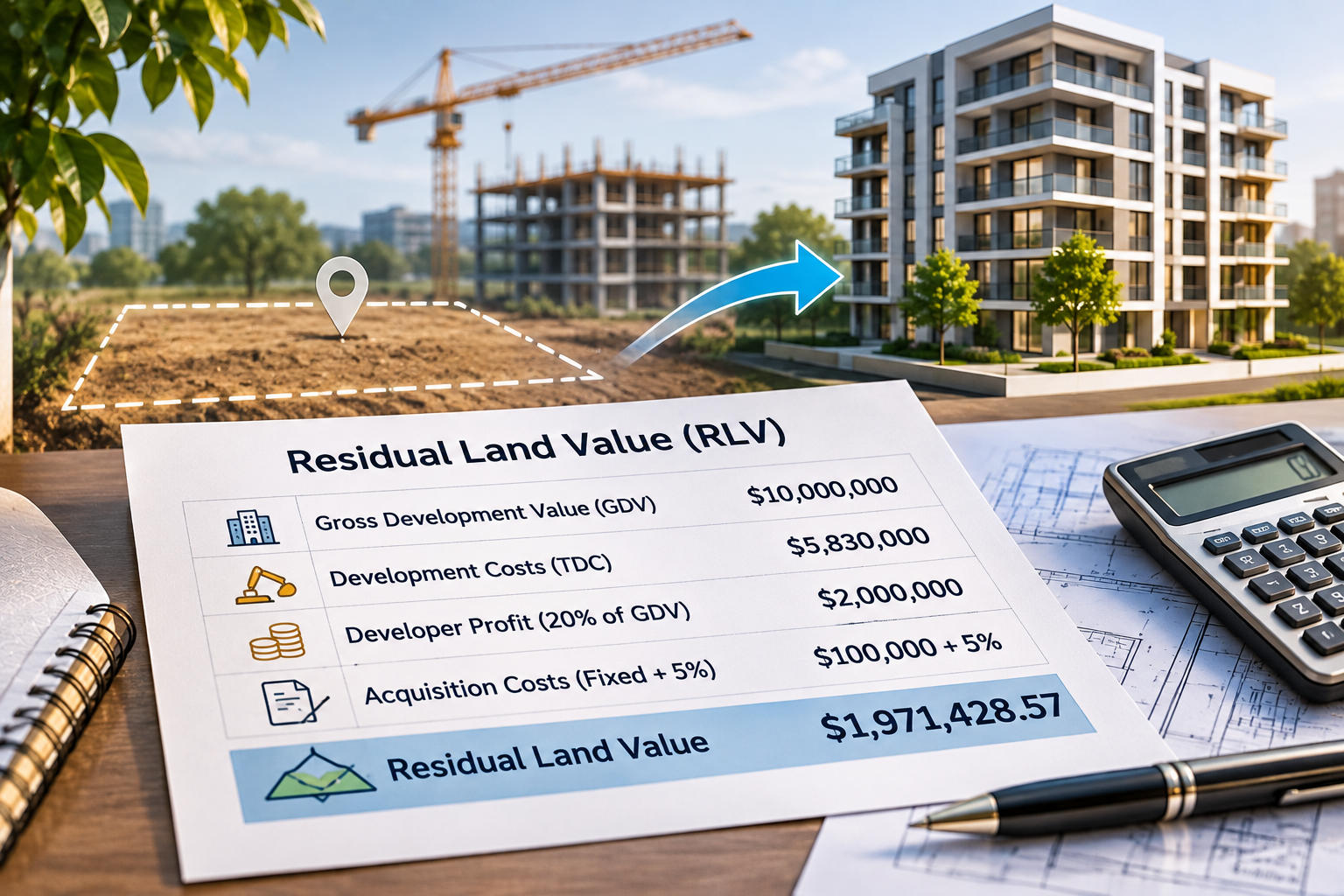
The actual calculation may also include acquisition costs, financing assumptions, taxes, and other project-specific items.
The important point is that GDV is no longer an isolated assumption. It has been generated from the site's development capacity, property allocation, and assumed selling rates.
This creates a connected calculation sequence:
Site area → Permitted floor area → Net saleable area → Property mix → GDV → Residual land value
If the permitted FAR changes, the gross floor area changes. That affects the net saleable area, which changes the area allocated to each property type and ultimately affects GDV.
Similarly, a revised selling rate changes the category-level value and the total GDV.
A connected model allows these changes to flow through the calculations rather than requiring the analyst to manually update multiple disconnected figures.
11. Important assumptions beyond the code
The calculator deliberately uses a small number of inputs. A real development feasibility assessment needs additional checks before treating the calculated capacity or GDV as reliable.
Planning controls: FAR alone does not establish the final achievable building area. Height, setbacks, coverage, parking, access, open-space requirements, and other planning conditions may constrain the design.
Measurement conventions: Gross floor area, gross internal area, net internal area, and saleable area are not interchangeable. Their definitions may vary by jurisdiction and valuation practice.
Development efficiency: The efficiency ratio should reflect the proposed building type and design rather than being treated as a universal percentage.
Property mix: The assumed allocation between residential, retail, office, or other uses must be supported by the development concept and applicable planning permissions.
Selling rates: The assumed rates should reflect relevant market evidence, property specifications, location, and expected market conditions.
Absorption and timing: GDV in this tutorial represents total estimated completed value. It does not model when units are sold or when payments are collected.
These considerations are important because a technically correct calculation can still produce an unreliable feasibility result when its underlying assumptions are weak.
Conclusion
Estimating development capacity is an important step in real estate feasibility analysis. Site area and FAR provide an initial estimate of gross floor area, while development efficiency helps translate that area into a potential saleable area.
By allocating the saleable area across property types and applying assumed selling rates, we can calculate a structured Gross Development Value.
Python makes these relationships reproducible and testable. More importantly, it allows each assumption to remain connected to the calculations it influences.
The resulting GDV can then feed into a residual land value assessment, where development costs and required developer profit are deducted to estimate the land consideration a project can support.
The reliability of the final result still depends on planning constraints, design feasibility, market evidence, and the consistency of the assumptions used throughout the model.
Comments
Join the discussionNo comments yet. Be the first to comment.